
Clinical Rotations with PACE Programs Introduce Fellows to the ‘Dream Model for a Geriatrician’
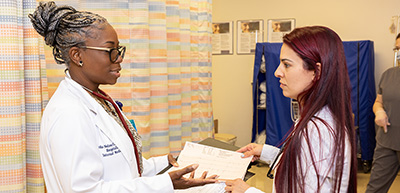
When Janelle Ho, MD, MHS, a physician at On Lok PACE in San Francisco, CA, completed a fellowship rotation with a Program of All-Inclusive Care for the Elderly (PACE) organization, she had the opportunity to consider participants’ needs from a more holistic perspective. It was part of what motivated her to pursue a position with a PACE organization once her fellowship concluded.
PACE encourages care providers to consider the broader context of their participants’ lived experience and what matters most to the participant, said Dr. Ho. “I entered medical school thinking, ‘I want to be a thoracic surgeon.’ But my whole early education journey was realizing that going into a subspecialty such as cardiothoracic surgery would not allow me to treat someone as a whole person.”
Dr. Ho explained that all subspecialties, including cardiothoracic surgery, are vital, but it bothered her that in her target field, she “couldn’t take care of someone with the lens of their diagnosis, their house, their family, their beliefs.” It irked her for a long time. But through PACE, Dr. Ho was exposed to a model of care that could fill in those gaps and bring a greater sense of fulfillment to her work.
PACE places a distinct value on the participants’ lived experiences and the context of their care, incorporating their perspective into care providers’ work. The value placed on PACE enrollees’ perspectives on their own care is the reason they are generally referred to with the term “participant” rather than the traditional term “patient.”
Addressing what matters most to participants also appealed to Sarah Babineau, MD, a physician at Providence ElderPlace Washington in Seattle, WA. Dr. Babineau said that she valued centering care planning around the big picture of what matters to participants rather than purely focusing on the granularity of things like blood pressure or diabetes management.
She said, as an example, that if someone with chronic obstructive pulmonary disease (COPD) has a goal to prioritize comfort and truly values having a cigarette each day, she appreciates the approach of saying, “Let’s educate him about his decision but also let him live the life he wants to live with his comfort-focused goals.”
Understanding Participants Holistically
Dr. Ho and Dr. Babineau cared for hospitalized PACE participants during residencies before eventually completing rotations with PACE during fellowships.
PACE providers would come to the hospital to consult with the staff there, Dr. Babineau said. She recalled “seeing the participants and their families breathe a sigh of relief that this person that knows them – knows them holistically – was there to advocate for them.”
Dr. Ho shared a similar experience. During her medicine residency with Johns Hopkins in Baltimore, MD, she had to meet with the family of a hospitalized PACE participant, so she emailed the participant’s primary care provider, a PACE physician. He asked what time the meeting was and arrived with several other PACE staff, including the participant’s social worker, nurse practitioner and chaplain.
Looking back, Dr. Ho said that experience demonstrated exactly what the PACE model of care is at its core. The participant’s care providers were present for them, providing support and expertise from multiple disciplines, including valuable insight from team members with backgrounds in fields other than medicine.
Exposure to Complexities Including Transitions of Care
The physician in Dr. Ho’s story was Matthew McNabney, MD, medical director at Hopkins ElderPlus, a PACE program in Baltimore. He also works as a preceptor and sits on the National PACE Association (NPA) Clinical Rotation Workgroup, which focuses on the development of curricula for post-graduate training in PACE, including for geriatric fellowship programs. The workgroup aims to develop strategies for PACE organizations to promote PACE as a model of care and employer of choice.
PACE fellowship rotations are designed to provide learners with the opportunity to work directly with older adults who have multiple medical conditions and need a wide range of health care services. This allows learners to gain practical knowledge and exposure to the complexities that can come with caring for older adults.
Dr. McNabney said that one of the elements he hopes stands out for fellows involved with PACE is working across transitions of care, providing for participants’ needs as they move through different care settings. For example, PACE staff must consider how to meet participants’ needs as they go from their home to the hospital, to a rehab center, then back home.
Outside of PACE, trainees might be learning how to practice in a specific care setting, “but when you’re trying to bridge those two settings and communicate across those bridges, it’s a whole different skill set,” he said.
The emphasis on transitions of care during her rotation with PACE allowed Dr. Babineau to gain a deeper understanding of participants’ care needs. “It wasn’t just a snapshot of them in the hospital; it was the larger context of their care,” she said.
Collaboration Within an Interdisciplinary Team
Because the PACE model includes a wide range of care professionals collaborating to provide comprehensive care for participants, another crucial element of fellows’ PACE rotation is witnessing interdisciplinary team (IDT) interactions firsthand.
While Dr. McNabney occasionally makes decisions independently, it is unusual not to think about the perspective or the input of another member of the team. It is amazing for trainees to witness that level of collaboration, he said, and they carry that experience forward with them.
“Having all of those brains thinking about these interesting, complex and beautiful people is super powerful," said Dr. Babineau. "So being able to sit in on those meetings on a weekly basis is just really cool.”
“It still never fails to surprise me all the things that I have not thought about this patient that come from the rest of the IDT,” said Dr. Ho.
Dr. Ho and Dr. Babineau said exposure to the perspectives of other team members allowed them to learn about care through the lens of different disciplines. After working so closely with people in other fields, they even find themselves adopting those perspectives at key moments, which increases their insight. “That’s a luxury of working in the PACE model," said Dr. Ho. "You not only get the input [of other team members], but you can put on their hat and think like they do.”
When she first started working in PACE, she didn’t anticipate the amount of collaboration she would have with the rehab team at her organization. “It definitely changes my perspective. When I go on a home visit," she said. "Even without them, I know what they would be looking for. I know they'll be counting the steps and measuring the distance to the bathtub.”
Learning What Makes PACE a Fulfilling Career Environment for Providers
PACE is also a great environment for fellows because they often have access to staff who have spent a large part of their career with PACE. This allows fellows to hear firsthand what PACE staff enjoy about their jobs and what keeps them there.
“A career is a long time, and if you’re not sure how you’re going to feel about what you’re doing 10, 15, 20 years down the road, it’s unnerving,” said Dr. McNabney. “But if you can talk to somebody who, no matter what their discipline is, has been doing it for 20 years and they convey with sincerity how much they still love what they do, that’s really important.”
Drs. McNabney, Ho, and Babineau agreed that working in PACE, whether it is during a rotation or on a permanent basis, allows geriatricians to put into practice the years of training they undergo.
“If you’re trained in geriatrics, you want to be able to do what you were trained to do,” said Dr. McNabney. "You want to be in a place that’s specifically designed to require and need the skills that you have. That’s one of the great things about PACE; it’s a community of people who need the things that you’re trained to do."
“As a trainee, we feel like we're this little hamster on a wheel a lot of times,” said Dr. Ho. "We prescribe things, and it feels like they come back in the [emergency department] the next day. I put referrals to physical therapy, not knowing what they will do with it."
When she worked in a fee-for-service model, she would think, “It's almost like I'm putting things in the chart just to make me feel like I've done something. The most impactful part of being in the rotation is actually seeing people get physical therapy the same day after saying I would like some help evaluating for X, Y and Z. PT is really good at that.’”
Seeing participants get the care that they are meant to receive is a confirmation of what is possible in health care, said Dr. Ho.
Geriatricians who choose to work in PACE after their fellowship ends continue to experience those benefits throughout their career, said Dr. Babineau. “I’ve looked at other practices, and PACE is the dream model for a geriatrician.”